From July 5 to 7, 2026, Professor Zhao Minghao, Deputy Director of the Center for American Studies at Fudan University, visited Singapore to attend the eighth Singapore–China Forum. He also met with representatives of Singapore’s government, business, and academic communities and Chinese entrepreneurs expanding overseas, conducting research on Southeast Asia and China–U.S. relations, Singapore–China cooperation, and the internationalization of Chinese enterprises.
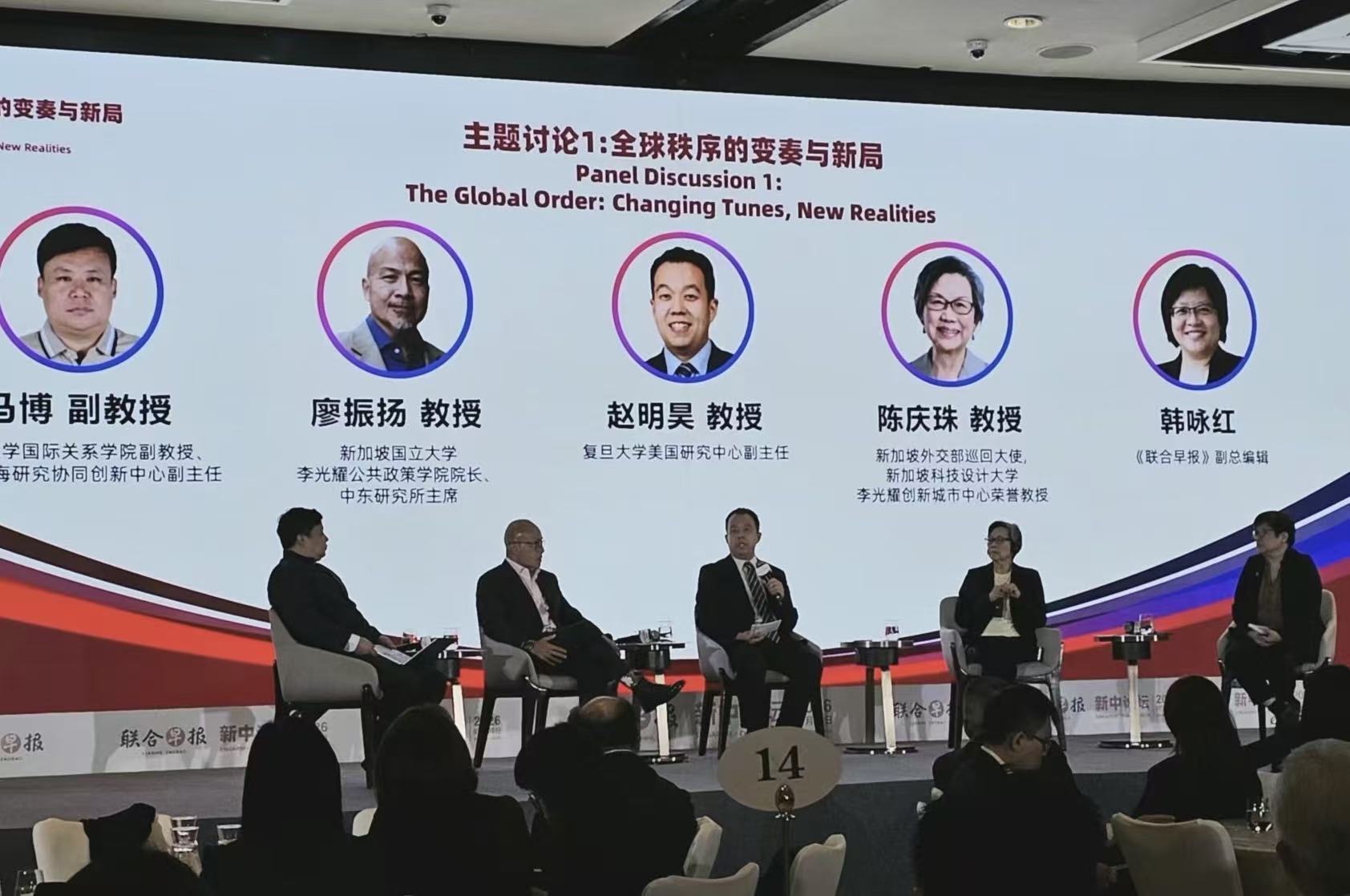
On the morning of July 6, Singapore’s Minister for National Development Chee Hong Tat delivered the keynote address at the forum’s opening ceremony. He emphasized that China had reached world-leading levels in many technological fields and that cooperation between Singapore and China must keep pace with changing circumstances to ensure benefits for both sides. Participants included Cao Zhongming, Chinese Ambassador to Singapore; Liu Hong, Deputy Editor-in-Chief of Xinhuanet; several Singaporean Members of Parliament; and senior officials from the Ministry of Foreign Affairs, the Ministry of Digital Development and Information, and other ministries. More than 300 participants from the government, business, and academic communities of Singapore and China explored the challenges and opportunities arising from profound changes in international affairs under the theme “The Global Order: Changing Tunes, New Realities.”
Zhao was invited to speak in the first session and joined Chan Heng Chee, Singapore’s former Ambassador to the United States; Joseph Liow Chinyong, Dean of the Lee Kuan Yew School of Public Policy at the National University of Singapore; and Ma Bo, Deputy Director of the China Center for Collaborative Study of the South China Sea at Nanjing University, in examining changes in the international order amid major-power competition. Zhao noted that China–U.S. summit diplomacy had made important progress, with the two countries agreeing to build a relationship of “constructive strategic stability.” He argued that U.S. President Donald Trump’s new remarks on Taiwan deserved attention and that mechanisms such as the Trade Council offered the two countries an opportunity to explore a “manageable” economic and trade relationship. With geopolitical conflicts continuing in the Middle East and Eurasia, he emphasized that preserving peace in the Asia-Pacific serves the common interests of China, Singapore, and other countries in the region, and that China and the United States also need to strengthen communication and avoid miscalculation.
That afternoon, Zhao participated in a closed-door discussion on “The Growing Wave of Chinese Enterprises Expanding into Southeast Asia.” Participants included Robin Hu, Advisory Senior Director at Temasek; Ron Sim, Chairman of the China & North Asia Business Group of the Singapore Business Federation; Teo Ser Luck, former President of the Institute of Singapore Chartered Accountants; Yang Wenhui, General Manager of Tencent Financial Technology, Asia Pacific; Yang Yudong, Editor-in-Chief of China Business News; and Weng Yongjun, founder of the Chinese restaurant brand Yong Fu. Zhao shared his views on the characteristics of the latest wave of Chinese corporate expansion overseas, how companies can respond to geopolitical risks, and the implications of China–U.S. technological competition for corporate compliance.
That evening, Zhao attended a Meet-the-People Session in Jurong to learn about Singapore’s governance practices. He also met with Grace Fu, Singapore’s Minister for Sustainability and the Environment and Minister-in-charge of Trade Relations, to discuss opportunities for cooperation between China and Singapore in green energy, artificial intelligence, and other fields. During the visit, Zhao also met with representatives of Temasek’s macro strategy department, DBS Bank, OCBC Bank, the National University of Singapore, Nanyang Technological University, Singapore Management University, and other institutions.