On the afternoon of May 26, 2026, the Center for American Studies at Fudan University (CAS Fudan) held its 60th Research Symposium to celebrate the University’s 121st anniversary. The symposium, themed “America at 250: A Golden Age or a Twilight Era?” featured presentations by Professor Zhang Yang of Fudan’s Department of History; Professor Wu Xinbo, Dean of the Institute of International Studies at Fudan University and Director of the CAS Fudan; Professor Song Guoyou, Deputy Director of the CAS Fudan; and Professors Pan Yaling and Wang Hao of the CAS Fudan. Professor Xu Yihua of the CAS Fudan chaired the symposium. Nearly 200 faculty members, students and alumni from Fudan and beyond participated in person or online. The anniversary symposium was also part of Fudan University’s 2026 Think Tank Week.


Professor Zhang Yang delivered a presentation entitled “Revisiting 1776: Founding Ideals, Historical Narratives and Contemporary Politics.” With the 250th anniversary of the founding of the United States approaching, she examined debates over national identity among American historians and their contemporary political implications. Beginning with competing narratives of the nation’s founding, she explored the deep connections among historical memory, national identity and contemporary politics. She noted that The New York Times’ 1619 Project seeks to trace the origins of American history to 1619, when the first enslaved Africans arrived in North America, reframing American history around race and challenging the traditional founding narrative centered on 1776. In response, the Trump administration established the 1776 Commission to counter the historical interpretation represented by The New York Times and defend traditional values. She argued that this confrontation reflected a profound division within mainstream American historical narratives. Although the Declaration of Independence proclaimed liberty and equality, the early republic in practice protected only the rights of white men. The gap between founding ideals and political realities has persisted throughout the country’s 250-year history. She further observed that, during the Cold War, the United States used narratives of a “mass consumption society” and “people’s capitalism” to obscure class conflict. Today, as post-industrialization intensifies, discontent among blue-collar workers has become an important social basis for the rise of American populism. Both historiographical controversies over race and contemporary disputes over populism and affirmative action reflect enduring contradictions and tensions between America’s core values and its social realities.

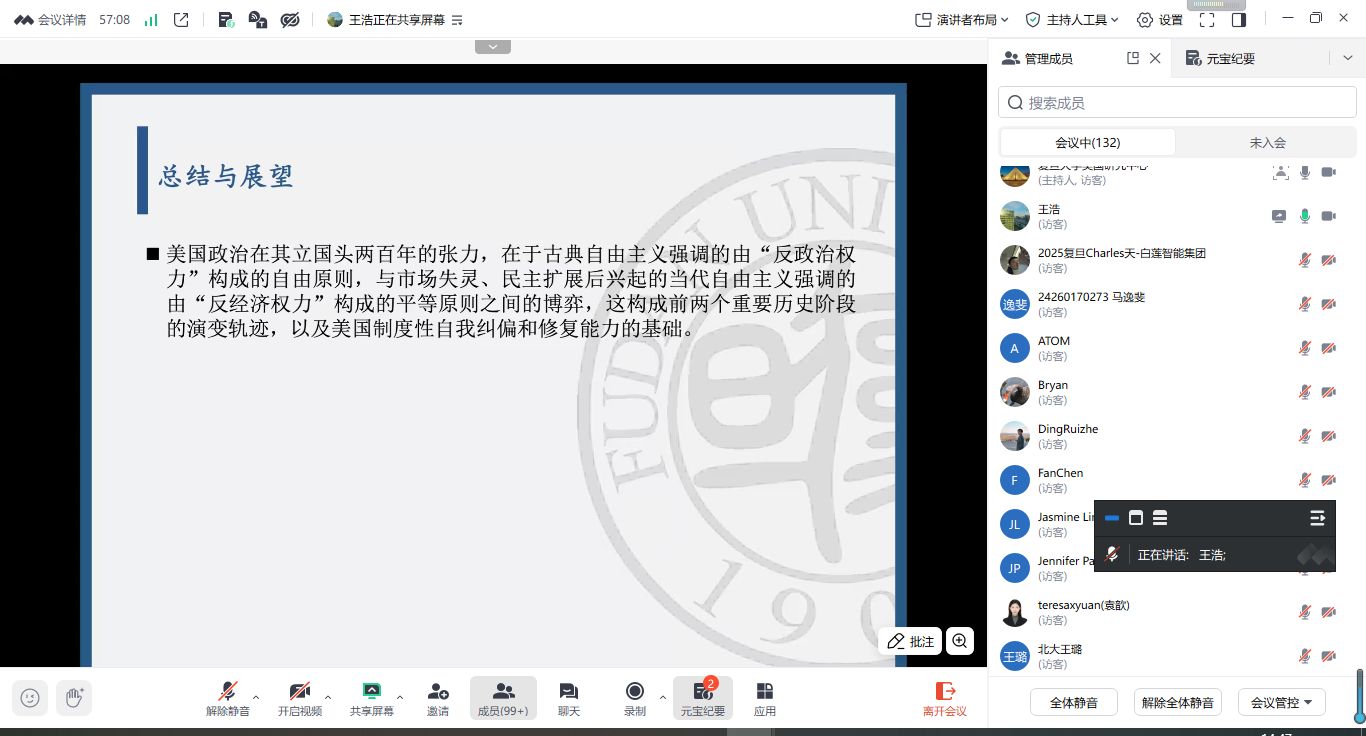
In his presentation, “American Politics at 250: Liberty, Democracy and Decay,” Professor Wang Hao examined the evolution of the U.S. political system over the 250 years since the nation’s founding and argued that it had entered a stage of “political decay.” He divided this evolution into three phases. The first, from the founding to the Civil War, was characterized by “limited democracy that prioritized liberty.” Guided by classical liberalism and republicanism, institutional design focused on restraining government power and protecting individual liberty, while democratic participation was restricted to white male property owners. The second phase, from the end of the Civil War to the 1960s, featured “democratic expansion and institutional adaptability.” To mitigate the internal contradictions of capitalism, constitutional amendments, Roosevelt’s New Deal and the civil rights movement progressively expanded voting rights and substantially increased government intervention. The third phase, encompassing roughly the past half-century, has been marked by “convergence under the influence of capital and political decay.” Wang argued that both major parties had been captured by capital, obstructing redistributive reform and encouraging recourse to identity politics as an alternative basis for mobilization. The resulting political polarization and “vetocracy” have significantly weakened the state’s capacity to govern. In his account, the central mechanisms of American political decay are the convergence of the two parties under the influence of capital and the use of identity politics as an alternative basis for political mobilization. The deep penetration of financial and technology capital has deprived both parties of incentives to address fundamental economic contradictions, leading them instead to amplify culture-war issues to maintain their governing coalitions and thereby hollow out American politics. He concluded that the country’s established mechanisms of cyclical self-renewal were failing: widening inequality and social fragmentation made it difficult to build consensus for substantive reform, placing the political system at risk of losing its capacity for self-correction.
Professor Song Guoyou’s presentation, “The U.S. Economy at 250: From a Golden Age to a Gilded Age,” challenged conventional accounts of the drivers of American economic growth and warned of current systemic economic risks. He identified several “unconventional drivers”: the demographic benefits of immigration and the attraction of global talent, with the labor supply and technological innovation provided by highly skilled immigrants constituting a key advantage over other advanced economies; the expansionary effects of the war machine, with territorial expansion, market development and industrial advancement often directly linked to war, from the Louisiana Purchase to the two world wars; and less visible state intervention, with tariff protection, industrial policy and crisis bailouts demonstrating that the U.S. government has long played an active economic role rather than serving purely as a night-watchman state. He argued that the U.S. economy faced two structural crises in a “new Gilded Age.” First, slower population growth, greater political uncertainty and the absence of stimulus from large-scale war were exhausting the drivers of growth, leaving the economy in an unremarkable state of low growth. Second, the three-part growth model centered on finance, consumption and technology was fragile: its high concentration, the accumulation of wealth among a small number of corporate giants and excessive reliance on capital-market bubbles created substantial instability.

Professor Pan Yaling delivered a presentation entitled “American Society and Culture at 250: A Place of Hope or a Land of Despair?” examining social and cultural change over the country’s 250-year history. On ideology, she argued that American liberals emphasized equality and diversity, whereas conservatives centered their values on white Anglo-Saxon Protestant men (WASPM), sought to dismantle diversity, equity and inclusion (DEI) initiatives, and promoted nationalist and populist agendas such as “America First” and “Make America Great Again.” In her assessment, American ideology had undergone a conservative reversal since Trump’s first administration. On moral values, she noted that personal character had traditionally been regarded as a prerequisite or safeguard for the proper exercise of public office by American leaders. Since 2016, however, Trump’s strongest supporters had often remained silent about what she described as his poor personal character. She argued that the United States was no longer a model of democracy, citing a third wave of “No Kings” protests against the Trump administration’s regressive policies, and characterized the country’s overall moral standards as having reached a low point. On race, she stated that U.S. Immigration and Customs Enforcement (ICE) had intensified enforcement against undocumented immigrants under Trump, while the administration had deployed the National Guard and the Marine Corps to major U.S. cities and used sensitive government databases to track undocumented immigrants. She cited figures of 595,000 arrests and more than 2.5 million deportations in 2025 alone, arguing that rising racism and xenophobia had exposed minority communities to multiple pressures and sharply intensified racial tensions. Turning to the country’s cultural foundations, she criticized the administration’s revival of the 1776 Commission, closure of the Department of Education, and cuts to funding for universities and research institutions. In her view, these measures sought to impose a single narrative of a ‘glorious and great America’ across science education, culture and the arts and eliminate the influence of multiculturalism. She argued that these measures had seriously eroded the country’s cultural foundations. She concluded that, from a social and cultural perspective, the United States at 250 was no longer a place of hope but a land of despair.

Professor Wu Xinbo’s presentation, “U.S. Foreign Policy at 250: How Should We Understand Trump’s Legacy?” examined the profound changes and long-term effects that Trump’s presidency had brought to American foreign policy. He identified a return to realism as a defining feature of the second Trump administration’s foreign policy strategy, involving a realignment of U.S. capabilities and objectives and a reduced emphasis on ideology. He argued that its policies had disrupted the U.S.-led alliance system, diminished American influence in international organizations and weakened U.S. international leadership. In his assessment, Trump’s foreign policy was also accelerating the emergence of a multipolar world and the transformation of the international order, strengthening China’s determination to pursue independent technological innovation and creating opportunities for China to expand its international influence.

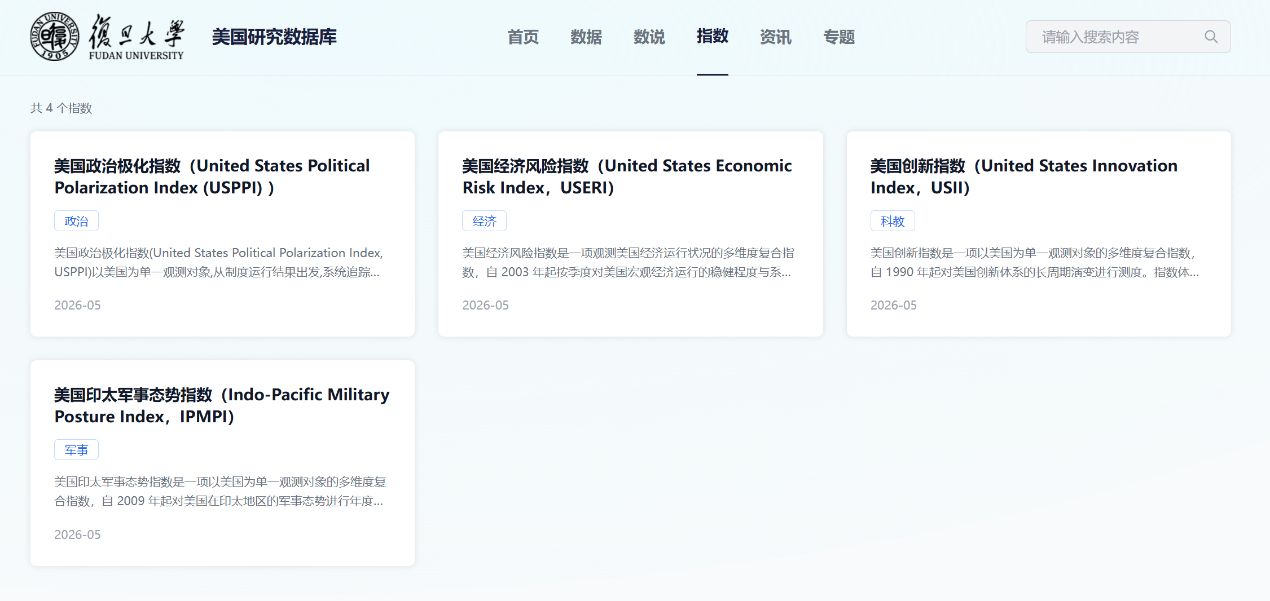
Following the anniversary symposium, the Center held a launch event for its American Studies Indices. Professor Wu Xinbo chaired the event, and Professor Song Guoyou introduced the U.S. Political Polarization Index, the U.S. Economic Risk Index, the U.S. Innovation Index and the U.S. Military Posture in the Indo-Pacific Index. The launch represents an important step in the CAS Fudan’s efforts to develop its American studies database and build an independent Chinese knowledge system for American studies. Faculty members and students from Fudan and other institutes can access the indices through the CAS Fudan’s website and IIS Fudan’s website, or by searching Baidu for “复旦大学美国研究指数” (Fudan University American Studies Indices).